
Objective:
Students will analyze how religious competition can challenge existing political institutions
and reshape society. They will apply concepts from public choice economics, institutional
competition, and transaction cost economics to understand the relationship between religion,
political power, and economic development.
Materials Needed:
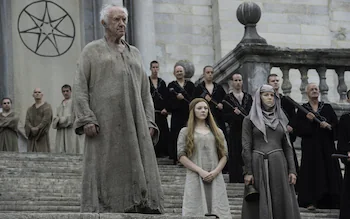
- Clip from Game of Thrones featuring Melisandre and worshippers of the Lord of Light.
- Handouts explaining institutional competition and legitimacy.
Lesson Steps:
- Introduction (10 minutes):
- Provide an overview of the role religious institutions played in medieval and early
modern societies. - Introduce the Protestant Reformation as a challenge to existing religious and political
authority. - Explain how competition among institutions can influence political and economic
outcomes. - Discuss how Stannis’s alliance with the Lord of Light represents a challenge to
established religious authority in Westeros.
- Viewing Clip (3 minutes):
- Show the clip featuring Melisandre leading worship of the Lord of Light and Stannis
publicly supporting the faith. - Ask students to identify how religion is being used to build political legitimacy.
- Group Discussion (10 minutes):
- Divide students into small groups to discuss:
- Why might rulers support new religious movements?
- How can religion strengthen or weaken political authority?
- Concept Application (15 minutes):
- Public Choice Model:
- Explain how political actors respond to incentives.
- Analyze the incentives facing:
- Stannis Baratheon.
- Melisandre.
- Religious followers.
- Discuss how leaders may use religious institutions to increase political support and
legitimacy. - Examine how religious leaders gain influence through alliances with political rulers
- Wrap-Up and Reflection (10 minutes):
- Recap public choice theory, institutional competition, and transaction costs.
- Discuss similarities between Westeros and Europe during the Protestant
Reformation.
- Homework/Activity (20 minutes):
- Assign students to compare the Lord of Light movement with a historical
religious reform movement. - Students must address:
- Political incentives.
- Economic consequences.
- Students present their findings in a 2–3 minute presentation.